Routine & Upkeep
Cleaning as You Go Beats a Saturday Blitz
The blitz model treats mess as something that accumulates and is then removed. In a one-person flat that guarantees the mess is always at its maximum on six days out of seven.

The points below about everyday cleaning habits are ordered by how much difference they make, not by how often they get repeated.
What matters most
- Fresh mess takes a fraction of the effort of dried or set mess.
- Distributed effort keeps the flat usable every day rather than one day a week.
- A blitz that keeps being postponed is a system with a single point of failure.
Why fresh mess is cheaper to remove
Almost every household mess is easier to deal with immediately, because drying, setting and hardening are what make cleaning difficult. A pan rinsed straight after use takes seconds, while the same pan left overnight requires soaking and scrubbing. Spills on a hob carbonise on the next use, and a wiped surface never reaches that state.
Limescale, soap scum and grease all build in layers, and each layer is harder to remove than the one before. The physical fact underneath all of this is that cleaning cost rises with time, which is what makes immediate action efficient rather than merely virtuous.
The single-point-of-failure problem
A weekly blitz depends on one block of time being available and on you being willing to spend it that way. Any bad week removes that block, and the mess then carries into the next week at a higher starting level.
The version that survives a bad week: two missed weeks produce a job large enough to be intimidating, which makes a third missed week more likely. Distributed effort has no single point of failure, since missing one day leaves the flat marginally worse rather than catastrophically so. This is why people who clean continuously appear to spend less time cleaning, and largely do.
What to do in the moment
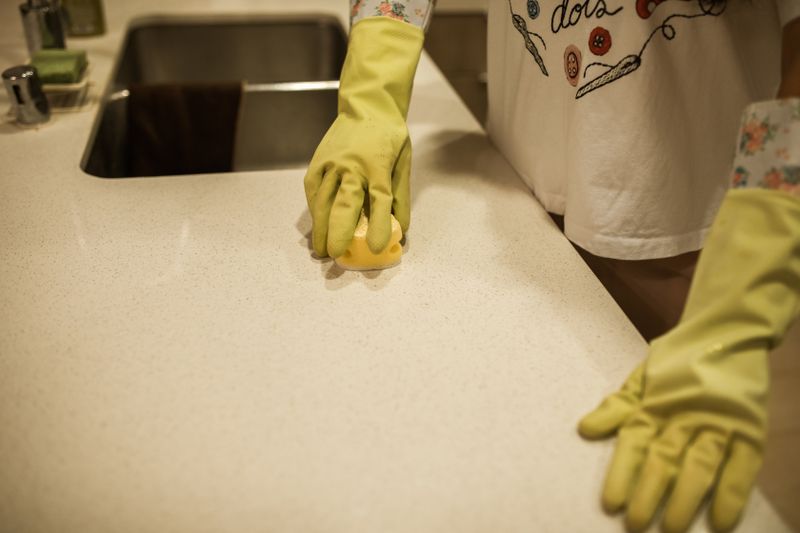
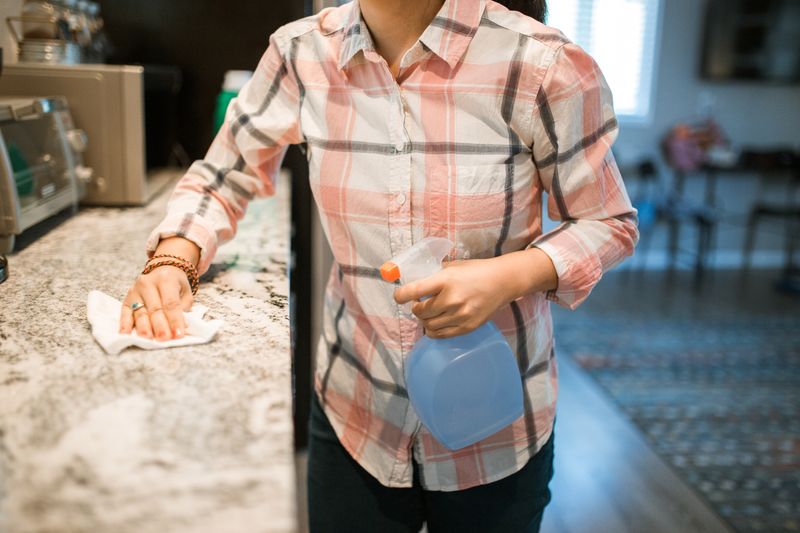
Wash or stack as you cook, using the time while something simmers rather than adding it to the end. Wipe the surface you just used before leaving the kitchen, which takes a few seconds and prevents everything that follows. Take something with you every time you leave a room, which clears most of the drift that accumulates in a flat.
In a small flat, deal with the shower after using it, since a quick squeegee or wipe prevents both limescale and mould. Put things away at the point of finishing with them rather than at the point of tidying, which is the whole habit in one sentence.
The jobs that still need a slot
Some tasks are genuinely periodic, including floors, bathrooms, bedding and anything requiring moving furniture. Those belong in a short weekly slot rather than in a whole afternoon, since a focused half hour covers most of them. Rotating one deeper task each week, whether the oven, the fridge or the windows, prevents any of them being neglected for a year.
Keeping the periodic list short is what keeps it happening, because a list of twenty jobs is a list nobody starts. The combination of continuous small actions and a short weekly slot handles a one-person flat comfortably.
Reducing the amount of cleaning required
Fewer surfaces holding objects means fewer surfaces to clear before cleaning, which is most of the time cost. A doormat and taking shoes off removes a surprising proportion of the dirt that ever enters the flat.
Lids on pans, a splash guard and a working extractor prevent grease reaching every surface in a kitchen. Storage that has room in it gets used, whereas full storage means things stay out on surfaces indefinitely. Cleaning less is mostly a design problem rather than an effort problem, and the design is under your control.
Tenancies differ, and whatever your own agreement says beats anything written generally.
Restarting after it slips
When the flat has got away from you, start with one visible surface rather than with a plan for the whole place. Work in short timed bursts, since a fifteen-minute limit is easier to begin than an open-ended session.
Do the kitchen first, because a functioning kitchen restores the ability to cook, which restores everything else. Accept a partial recovery, as a flat that is eighty per cent sorted is enormously better than one that is not started. The measure of a routine is how quickly it restarts, and every routine gets interrupted eventually.
Everything above, in order of what to do first
- Why fresh mess is cheaper to remove. Almost every household mess is easier to deal with immediately, because drying, setting and hardening are what make cleaning difficult.
- The single-point-of-failure problem. A weekly blitz depends on one block of time being available and on you being willing to spend it that way.
- What to do in the moment. Wash or stack as you cook, using the time while something simmers rather than adding it to the end.
- The jobs that still need a slot. Some tasks are genuinely periodic, including floors, bathrooms, bedding and anything requiring moving furniture.
- Reducing the amount of cleaning required. Fewer surfaces holding objects means fewer surfaces to clear before cleaning, which is most of the time cost.
- Restarting after it slips. When the flat has got away from you, start with one visible surface rather than with a plan for the whole place.
The takeaway
Deal with it while it is still wet, and keep the weekly slot short enough that you actually do it.
A home that works is a set of small systems, not one big clean.
Questions readers ask
Is a cleaning schedule worth writing down?
A short one helps, particularly for the periodic jobs that are easy to forget. A detailed daily schedule tends to become another thing to feel behind on.
How long should keeping a one-bedroom flat take?
Distributed across the week it is a small number of minutes a day plus a short weekly slot. Concentrated into one session it feels like far more, which is part of why the blitz model is unpopular.
Also by Zubin Wadia
- The Viewing Questions That Tell You More Than the PhotographsYour First Place
- What a Landlord Repairs and What Falls to YouYour First Place
- The Three Things You Only Notice After You Move InYour First Place
- Cooling Cooked Food Is the Step Almost Everyone SkipsCooking for One