Laundry & Clothes
Drying Clothes Indoors Without Turning the Flat Damp
A full load of washing carries a litre or two of water into your living room. That water has to go somewhere, and in a closed flat it goes into the walls.

Everything here earned its place by changing an outcome. Nothing about drying laundry indoors is included to round the number up.
What matters most
- A spun load still holds a substantial amount of water that ends up in the room air.
- A higher spin speed removes water for free and cuts drying time considerably.
- Ventilating the room the washing dries in is what prevents condensation elsewhere.
Where the water goes
Clothes dried indoors release their remaining water as vapour into the air of the flat, since there is nowhere else for it to go. That vapour raises the humidity of the whole space and condenses on the coldest surfaces, which are usually windows and external wall corners.
Persistent black spotting behind furniture in a flat with no obvious leak is very often a drying rack running twice a week. The amount is not trivial, since a washing machine removes most but not all of the water and a spun load still holds a meaningful quantity. Understanding this turns indoor drying from an unavoidable habit into a manageable one with two or three simple controls.
Spin harder before you dry
Spin speed is the cheapest dehumidifier you own, because water removed mechanically never has to be evaporated at all. Increasing the spin from a low setting to a high one removes noticeably more water and shortens indoor drying time substantially.
Cooking for one, the trade-off is creasing and mechanical stress, so delicate items keep a lower spin and towels and jeans take the highest available. An extra spin cycle on a heavy load costs a few minutes and very little electricity, and it is worth it for towels and bedding. Check the care label, since some fabrics specify a reduced spin and elastane in particular does not enjoy being wrung hard.
Where and how to hang it
Dry in one room with the door closed and a window open rather than spreading washing through the flat. That contains the humidity to a single space and lets it leave through the window instead of migrating into cold bedrooms. Space garments so air can move between them, since a packed rack dries from the outside in and takes twice as long.
On a Sunday evening, never dry clothes directly on a radiator or a heater, as it blocks the heat output, slows the room warming and can be a fire risk on some appliances. A rack near a radiator with the window slightly open is the good version, because you get the airflow and the heat without covering anything.
Ventilation and dehumidifiers
Short bursts of wide ventilation remove moist air faster than a permanently cracked window and cool the walls less. An extractor fan in a bathroom used as a drying room is doing exactly the job it was designed for. A dehumidifier in the drying room is genuinely effective, collecting the water into a tank rather than letting it into the fabric of the building.
Some dehumidifiers include a laundry mode, which simply runs the fan harder to circulate air over the washing. The running cost is real and usually compares favourably with a tumble dryer for the same load.
Speeding it up without heat
Airflow matters more than temperature, which is why a fan pointed at a rack dries clothes faster than a warm still room. Turn thick items such as jeans and towels once during drying, since the folded sections dry last and hold moisture longest.
Cooking for one, hang shirts on hangers rather than folded over a rail, which both speeds drying and removes most of the need to iron them. Dry heavy items first when the room is at its driest, and add light items later once the first load is nearly done. Anything still damp at the end should be finished properly rather than put away, because fabric put away damp develops mould and smell.
Tenancies differ, and whatever your own agreement says beats anything written generally.
The line outside, when you have one
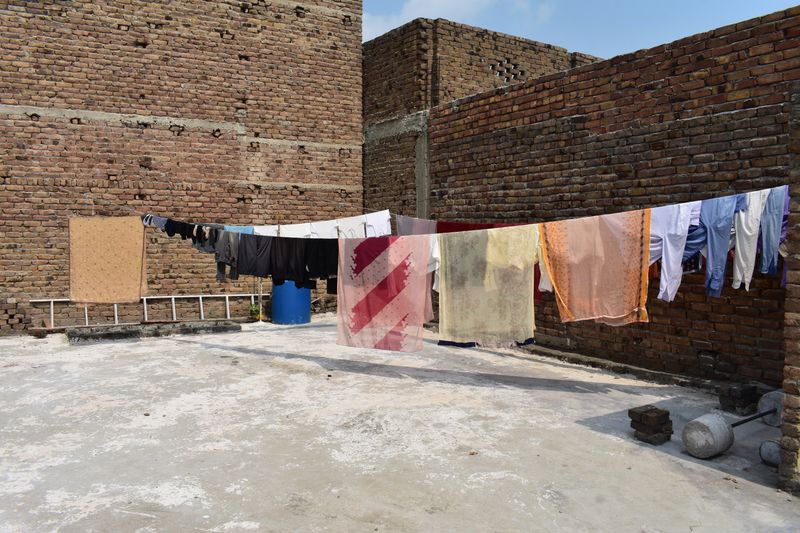
Outdoor drying is faster, free and gentler on fabric than any machine, and sunlight has a mild bleaching effect on white cotton. That same effect fades dark and coloured items, so turn them inside out or dry them in shade where the care label asks for it. Wind does most of the work rather than sun, which is why a bright still day can be slower than a grey breezy one.
Once the deposit is down, many tenancy agreements and building rules restrict balcony drying, so check yours before assuming it is available. Where outdoor drying is possible even occasionally, it removes the humidity problem entirely for those loads.
Everything above, in order of what to do first
- Where the water goes. Clothes dried indoors release their remaining water as vapour into the air of the flat, since there is nowhere else for it to go.
- Spin harder before you dry. Spin speed is the cheapest dehumidifier you own, because water removed mechanically never has to be evaporated at all.
- Where and how to hang it. Dry in one room with the door closed and a window open rather than spreading washing through the flat.
- Ventilation and dehumidifiers. Short bursts of wide ventilation remove moist air faster than a permanently cracked window and cool the walls less.
- Speeding it up without heat. Airflow matters more than temperature, which is why a fan pointed at a rack dries clothes faster than a warm still room.
- The line outside, when you have one. Outdoor drying is faster, free and gentler on fabric than any machine, and sunlight has a mild bleaching effect on white cotton.
The takeaway
Spin it harder, dry it in one room with the window open, and never let anything go away damp.
Living alone is a skill, and every skill looks like luck from outside.
Questions readers ask
Is a heated airer cheaper than a tumble dryer?
Usually yes to run, because it uses far less power, and it is much slower. It still releases the water into the room, so ventilation matters just as much.
Why do my clothes smell after drying indoors?
Because they dried too slowly and stayed damp long enough for bacteria to grow. More airflow, a harder spin and a smaller load on the rack all fix it.
Also by Bilal Ahanger
- The Freezer Is the Most Useful Appliance One Person OwnsCooking for One
- The Washing Machine Symbols Are a Temperature and Agitation CodeLaundry & Clothes
- Sorting Laundry by Colour Is the Least Important SortLaundry & Clothes
- Tumble Dryers, Heat and the Lint That Actually MattersLaundry & Clothes